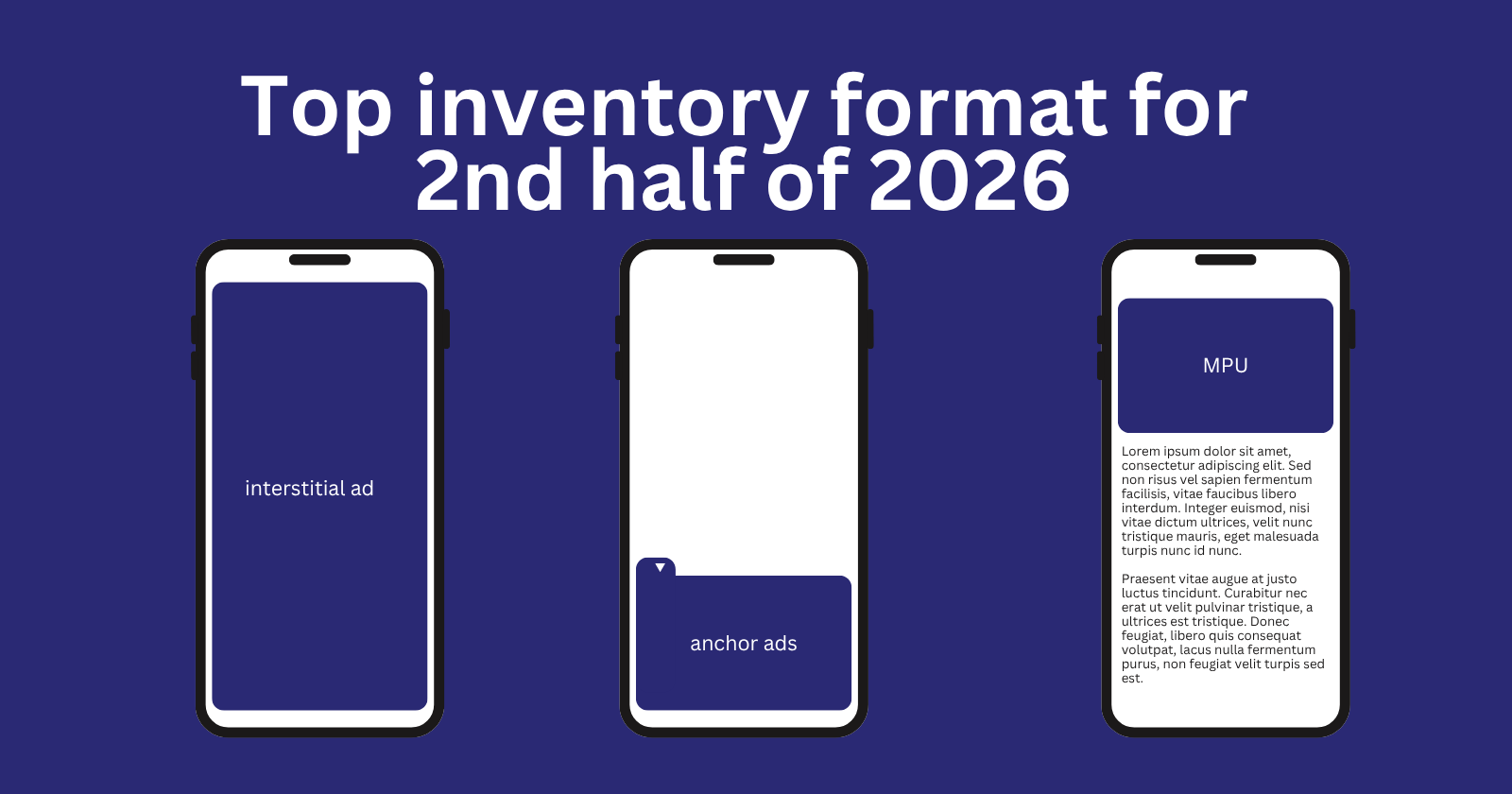
Category: Web monetisation

  • The Revenue Blueprint: Identifying Top-Performing Ad Formats in 2026

    The Revenue Blueprint: Identifying Top-Performing Ad Formats in 2026

    In the world of digital publishing, not all ad impressions are created equal. You could have two websites with identical traffic, yet one might earn double the revenue simply because of how they’ve structured their “inventory.”

    As we move through the second half of 2026, the digital advertising landscape has shifted. We are no longer in an era where you can just “slap a banner on it” and hope for the best. Advertisers are now hyper-focused on viewability, engagement, and—most importantly—how an ad affects the user’s journey.

    If you want to maximize your site’s earning potential, you need to understand which formats are currently dominating the market and, crucially, why they command higher premiums. Here is a deep dive into the top-performing inventory formats for today’s publishers.

    1. The Medium Rectangle (300×250)

    If there is one “king” of display advertising, it is the 300×250 medium rectangle. Despite being one of the oldest sizes in the book, it remains the most sought-after inventory by advertisers globally.

    Why it performs:

    • Versatility: It is small enough to fit in a sidebar but large enough to sit comfortably within the flow of an article.

    • Competition: Because almost every advertiser has a 300×250 creative ready to go, the auction pressure for this slot is immense. High competition leads to higher CPMs.

    • Viewability: When placed “above the fold” or embedded within high-engagement text, it consistently scores high viewability marks, which is a key metric for premium programmatic buyers.

     

    Medium rectangle ad format encircle for recognition on a web page
    MPU Ad inventory format


    2. The Revenue Accelerator: Interstitial Ads

    If you’re looking for a format that moves the needle on revenue quickly, Interstitials (full-screen ads) are unparalleled. In 2026, mobile interstitials have become a gold standard for publishers looking to monetize natural transitions in user behavior.

    Why they perform:

    • Total Attention: Unlike a banner that occupies 10% of the screen, an interstitial occupies 100%. This eliminates “banner blindness” entirely.

    • Higher CPMs: Data from Yango Ads indicates that interstitials can command CPMs roughly 71% higher than standard banner placements. While a banner might fetch $2.50, an interstitial can easily push toward the $4.50–$4.80 range.

    • Strategic Timing: By appearing at “natural breaks”—such as when a user finishes an article or moves to a new page—they respect the user flow more than intrusive pop-ups, leading to higher engagement without the same level of frustration.

     

    A hand holding a mobile phone with interstitial ad format in full view
    Interstitial ads format | Credit Verve blog


    3. The Mobile Specialist: The 320×100 Large Mobile Leaderboard/Sticky

    On mobile, real estate is expensive. While the 300×50 “leaderboard” used to be the standard, the 320×100 (Large Mobile Banner) has taken its place as the top-performing mobile format.

    Why it performs:

    • Twice the Space: It offers double the vertical height of a standard mobile leaderboard banner, allowing for much more compelling call-to-action (CTA) buttons and imagery.

    • Better Viewability: It’s large enough to be noticed but small enough to remain “anchored” to the bottom of a screen (sticky ads) without ruining the mobile browsing experience.

    • High Fill Rates: Like the 300×250 on desktop, the 320×100 is a “universal” size that nearly all mobile demand sources prioritize.

    PRO TIP: If you use Google Ad Manager, the industry standard for web ads management, you can make this particular format collapsible. Hence, it will initially appear like an MPU from the bottom of the screen but will be collapsible to a 320×100 size. See image below:
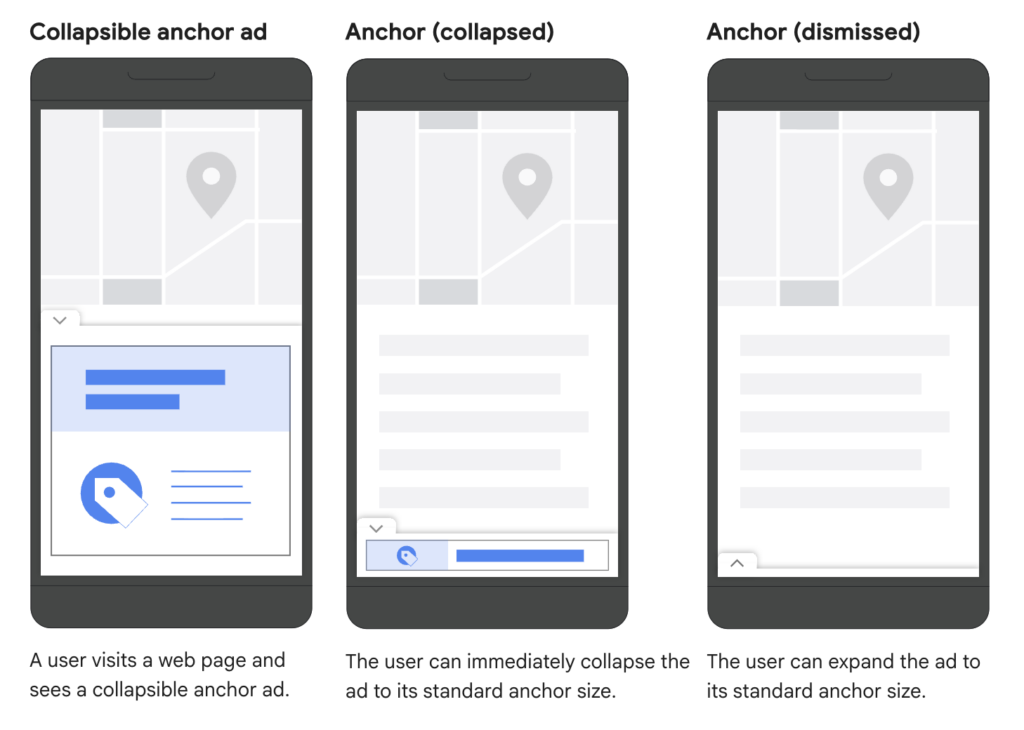
    collapsible anchor ads format illustrated
    collapsible anchor ads format illustrated | Credit Google blog post


    4. The Growth Leader: Native Advertising

    Native ads are designed to “blend in” with the editorial look and feel of your website. Whether it’s a “Recommended for You” widget at the bottom of a post or a sponsored article in your feed, native is projected to hit $116 billion in spend by the end of 2025 in the U.S. alone.

    Why it performs:

    • Trust Factor: Because native ads don’t look like traditional ads, users are significantly more likely to engage with them. Studies show that consumers trust brands that utilize user-generated content (UGC) or native-style ads up to 84% more than studio-produced banners.ssss

    • Higher CTR: Native placements typically achieve click-through rates that are 4x to 5x higher than traditional display ads.

    • Ad-Blocker Resilience: Because they are integrated into the content flow, native ads are often more difficult for traditional ad-blockers to identify and strip away compared to standard “AdX” tags.

    Photo credit: Enterpreneur


    The “Why” Behind the Success: User Experience (UX)

    The common thread among all top-performing formats in 2026 is relevance and respect. Advertisers are moving away from formats that “trick” users into clicking. Instead, they are paying a premium for formats that provide a Clear Value Proposition within 2–3 seconds. Whether it’s an interstitial that respects a natural break or a native ad that provides genuine value, the ads that perform best are the ones that treat the user like a human, not just an “impression.”

    If you are still relying on a single 728×90 banner at the top of your site, you are likely leaving thousands of dollars on the table. By diversifying into high-impact formats like video and interstitials, you don’t just increase your revenue—you future-proof your business in an increasingly competitive digital world.

  • AdSense to Ad Manager: When to Switch

    AdSense to Ad Manager: When to Switch

    If your website is currently generating $2,000/month on AdSense, you’re likely feeling pretty good about your monetization. But here is the reality: a successful move to Google Ad Manager (GAM) could realistically push that same traffic to $3,000–$3,500/month.

    You aren’t creating more content. You aren’t buying more traffic. You are simply selling your existing ad space more efficiently.

    Moving from Google AdSense to GAM is a strategic shift from being a passive participant in an ad network to running your own professional ad desk. While AdSense is the gold standard for simplicity, GAM provides the granular control needed to maximize the value of every single pageview.

    Here is everything you need to know about making the leap in 2026.

    📈 When to Make the Move: The “Signal” Checklist

    Traffic volume is the most common metric people cite, but it isn’t the only one. You should consider the switch when your business requirements evolve in these four specific ways:

    1. You’ve Started Receiving Direct Deal Inquiries

    When a brand reaches out and says, “We want to buy the header banner on your homepage for the next 30 days at a fixed price,” AdSense cannot help you. You need an ad server to “book” that inventory, set a specific impression goal, and ensure it delivers. GAM allows you to manage these “Guaranteed” deals alongside your programmatic ads.

    2. You Want to Introduce Header Bidding

    In AdSense, you are essentially in a closed loop. By moving to GAM, you can implement Header Bidding—a setup where multiple ad networks (like Rubicon, PubMatic, or Amazon) compete against Google for your ad space simultaneously. According to industry data, opening your inventory to this level of competition can drive CPMs 30–70% higher than AdSense alone.

    3. You Manage a Multi-Platform Ecosystem

    If you have a website, a mobile app, and perhaps a video player, managing three different dashboards is a recipe for inefficiency. GAM acts as a centralized brain for your entire digital footprint, allowing you to organize and report on all platforms from a single login.

    4. You’ve Outgrown “Basic” Reporting

    AdSense tells you how much you earned. GAM tells you why you earned it. You get deep analytics on specific audience segments, device latency, and geographic performance, allowing you to prune low-performing areas of your site and double down on high-value ones.

    🛠 Why This Increases Revenue: The Power of Dynamic Allocation

    The primary engine behind the revenue jump in GAM is a feature called Dynamic Allocation. In the old “Waterfall” model, if a direct advertiser didn’t buy the space, it would pass down to the next network, and then the next. This was slow and inefficient.

    Dynamic Allocation changes the game. It allows AdSense and Ad Exchange (AdX) to compete in real-time against your direct deals and other networks. If a programmatic buyer is willing to pay more than the “opportunity cost” of your direct deal, GAM will serve the higher-paying ad (while still ensuring your direct deal meets its monthly goal).

    The Result: You never leave money on the table. The system automatically picks the highest payer for every single impression on an individual, millisecond-by-millisecond basis.

    🚦 The Threshold: Is Your Site Ready?

    Before you hit the “sign up” button, you must be honest about your resources. Google Ad Manager is a professional-grade tool with a steep learning curve.

    • Traffic Requirement: While there is no “hard” limit for the free version of GAM, the industry consensus is that you should have at least 100,000 to 500,000 monthly pageviews.

    • The Learning Curve: Unlike AdSense’s “set it and forget it” Auto-Ads, GAM requires manual configuration of “Orders,” “Line Items,” and “Key-Values.”

    • Ad Ops: If you don’t have the time to spend 5–10 hours a week monitoring your ad health, the incremental gains may be eaten up by the “cost” of your time.

    🏁 The Winning Strategy

    The best path for most publishers is to stay with AdSense until you feel the friction of its limitations.

    When you find yourself turning down direct sponsors because you don’t know how to “slot” them in, or when you see your traffic plateauing but your revenue staying stagnant, that is your signal to migrate.

    The goal isn’t just to show ads—it’s to run a media business. AdSense is your entry-level internship; Google Ad Manager is your seat at the executive table.

    Feature Google AdSense Google Ad Manager
    Ease of Use High (Plug & Play) Low (Requires Training)
    Demand Sources Google Ads only Google + 3rd Party + Direct
    Competition Limited High (Dynamic Allocation)
    Direct Deals No Yes
    Best For Bloggers & Small Publishers Mid-to-Large Media Companies
    Revenue Potential Baseline Baseline + 20–50% Uplift

    Ready to make the jump? Start by auditing your current direct-deal inquiries. If the money is waiting at the door, it’s time to open it with GAM.